or Powell's or me
• •
"Mike and Jon, Jon and Mike—I've known them both for years, and, clearly, one of them is very funny. As for the other: truly one of the great hangers-on of our time."—Steve Bodow, head writer, The Daily Show
•
"Who can really judge what's funny? If humor is a subjective medium, then can there be something that is really and truly hilarious? Me. This book."—Daniel Handler, author, Adverbs, and personal representative of Lemony Snicket
•
"The good news: I thought Our Kampf was consistently hilarious. The bad news: I’m the guy who wrote Monkeybone."—Sam Hamm, screenwriter, Batman, Batman Returns, and Homecoming
June 12, 2016
The Return on My Investment
By: Aaron Datesman
It's easy to recognize a win when it comes with a trophy at the end (or, in the case of politics, an inauguration). It's harder to recognize a win when somebody else gets the credit, and very often impossible when the win involves an undesirable outcome avoided. Although it's difficult to answer the question "What might have been?" this is exactly the context in which we ought properly to evaluate the results of our actions.
I was reminded of this recently when President Obama announced his support for strengthening Social Security, on June 2nd. Just a few years ago, the landscape was very different. Obama's 2014 budget contained Social Security cuts amounting to about 0.25 percentage points:
If the chained CPI were implemented, Social Security benefits would be about $3 per month lower in 2014, and about $30 a month lower by 2023, according to Congressional Budget Office calculations. And by 2033, Social Security payments are projected to be 3 percent lower than they would be using the current measure of inflation.
Senator Sanders led the charge to reject adoption of the chained CPI, going on to make strengthening Social Security a central theme of his presidential campaign:
Lawson’s organization [Social Security Works] has worked with lawmakers and other nonprofit organizations to oppose Obama’s proposed Social Security cuts and shift the conversation towards expansion. By the summer of 2014, a small group of Democratic caucus senators, led by Sen. Bernie Sanders, started advocating for lifting Social Security’s payroll tax cap so wealthier people paid more into the system, and then increasing benefits to seniors. Polling by advocacy groups found broad support for expansion.
Two years later, here we are: Obama and Clinton, the presumptive nominee, are both on the record supporting Social Security expansion. One of them will get the win, but it's easy to make the case that Sanders deserves the credit. It's not provable, I suppose. Maybe I really want to believe it because I donated about $1000 to the Sanders campaign this primary season. My guy lost (or, properly, is going to lose), and maybe that was just money wasted.
But I don't believe that's so. In fact, I think I made a very smart investment. As if on cue, as it happens, I got an interesting letter in the mail the other day: my Social Security statement. It says on the front page
Your payment would be about $2442 a month at full retirement age.
The math is very easy to do. I'll be 45 years old this year, so we can use the figure of 3% lower in 2033 cited above with good accuracy. If the chained CPI had been implemented, my expected Social Security benefit would be lower by $879 per year. The net present value of that money is about $500.
So: Senator Sanders protected my Social Security benefits for the duration of my retirement. In exchange I donated an amount equal to two years' worth of the benefits that would have disappeared had the cut been implemented. I make out quite well! Now the program will be strengthened, and possibly benefits even increased. Of course, it's even better than this for me: I'm married, for one thing, so I'll share my wife's benefits. Also the same analysis extends to cover all of the people whom I love and care about (many of whom depend on Social Security, or will do so in the future).
I was lucky to be able to afford the money I donated (although it was a bit of a stretch). Actually this little calculation (based on a justifiable but unknowable assumption about where credit should go) was not the basis of my decision to donate to the Sanders campaign. But it makes me feel pretty good regardless. If I live to 85 years of age, I'll have something like $10,000 (2016 dollars) in additional retirement income thanks to Senator Sanders. This is a return of 10:1 (present day) on my $1000 in campaign donations.
When I first began to learn to look at the world in this way - by evaluating counter-factual situations ("What if the chained CPI had been implemented?") - I found my side winning a lot more battles than I had ever understood. I think it's a valuable lesson. Thank you, Bernie Sanders.
January 08, 2015
The Lighter Side of the Slaughter at Charlie Hebdo
There's not much funny about the massacre of twelve people in Paris yesterday. But it is genuinely funny, as well as completely predictable, that Marine Le Pen hopes to ride to power on their deaths.
Le Pen is the leader of France's far-right National Front, and came in third in the first round of the 2012 French presidential elections. She clearly plans to run for president again in 2017, and said today that "Islamists have declared war on France" and that "I want to offer the French a referendum on the death penalty."
What makes that funny is that the cartoonists at Charlie Hebdo despised Le Pen. Here's part of a recent interview with Jean Cabut, aka Cabu, who was murdered at age 76:
What made an impression on you in 2014?Jihad and the progress of the National Front. Moreover, they meet in the extreme, it is hatred that connects them. For jihad, the scapegoat is the West, for the National Front, it is the Arabs: it is a common front, an inverted front. How to stop this?
Will you get to draw about this?
Yes, soon. I often do covers on Marine Le Pen... the National Front wants to restore the death penalty...This is very dangerous. We should use stupidity against itself, but how?
This is that section of the Cabu interview in French, please tell me if I translated anything incorrectly:
Qu’est-ce qui vous a marqué dans cette année 2014?
Le jihad et la progression du Front national. D’ailleurs, ils se rejoignent dans les extrêmes, c’est la haine qui les tient. Pour le jihad, le bouc émissaire, ce sont les Occidentaux, pour le Front National, ce sont les Arabes : c’est un front commun, un front renversé. Comment arrêter cela ?
Vous arrivez à dessiner sur ce sujet?
Oui, j’y arrive. Je fais souvent des couvertures sur Marine Le Pen car le Front national fait peur. C’est un parti attrape-tout. On dirait qu’il y a une fatalité. On entend l’opinion publique : on a tout essayé, il n’y a que cela qu’on n’a pas essayé. Même s’il n’en parle jamais, le Front national veut rétablir la peine de mort, le service militaire. C’est très dangereux. Il faudrait retourner la bêtise contre elle-même, mais comment ?
—Jon Schwarz
January 06, 2015
Report: Top Israeli Politician Naftali Bennett Played Key Role in 1996 Massacre That Motivated Bin Laden and Al Qaeda to Attack U.S. on 9/11
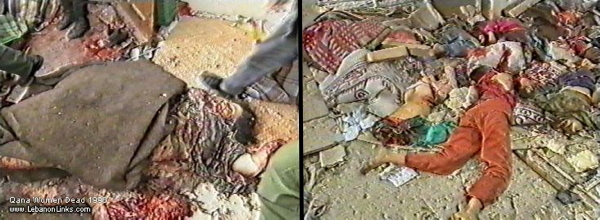
Naftali Bennett is Israel's Minister of the Economy and leader of the ultra-right wing religious party Jewish Home. He's also a leading candidate to be Israel's next Defense Minister, and as the New Yorker describes it, his ambition to one day become Prime Minister is "as plump and glaring as a harvest moon."
Now the Israeli newspaper Yedioth Ahronoth is reporting that Bennett bears significant responsibility for Israel's 1996 massacre of 106 civilians taking shelter at a UN compound in Qana, Lebanon. According to Yedioth Ahronoth, Bennett – then an officer in an IDF commando unit – had contempt for his superiors' purported timidity in Israel's Operation Grapes of Wrath, and ignored orders in order to move more aggressively into Lebanon. His unit was then attacked by Hezbollah, and when Bennett called for help, the IDF responded with the shelling of the UN compound.
Members of the artillery battery itself said "no one spoke about it as if it were a mistake. We did our job...A few 'arabushim' [slur for Arabs] die, there is no harm in that." An Amnesty International investigation found that "the IDF intentionally attacked the UN compound, although the motives for doing so remain unclear." Human Rights Watch reported that Israel had an "appalling willingness to conduct military operations in which civilians would bear the brunt of the suffering" and that its "claims that it had no knowledge that hundreds of civilians were sheltered at the Qana base are simply not credible." And the UN found "it is unlikely that the shelling of the United Nations compound was the result of gross technical and/or procedural errors." (The U.S. was infuriated that Boutros Boutros-Ghali, then-Secretary General of the UN, published the UN investigation. Subsequently the UN Security Council voted 14-1 to appoint Boutros-Ghali to a second term; the one no vote was a veto from the U.S.)
But the Qana massacre got barely any attention from Americans, and to whatever degree anyone noticed it, they quickly forgot it had ever happened.
Not everyone forgot, however.
In Osama bin Laden's 1996 declaration of war upon the U.S., he specifically cited Qana as part of his motivation:
It should not be hidden from you that the people of Islam had suffered from aggression, iniquity and injustice imposed on them by the Zionist-Crusaders alliance...The horrifying pictures of the massacre of Qana, in Lebanon are still fresh in our memory.
Bin Laden cited Qana at least four more times: in a July, 1996 interview with Robert Fisk; a November, 1996 interview with a London newspaper; a 1999 interview with al Jazeera; and an October, 2001 online interview. He specifically said his goal was to make Americans "taste what we tasted."
In addition, Mohammed Atta signed a will at the beginning of Operation Grapes of Wrath. In Lawrence Wright's book The Looming Tower, he writes that "According to one of his friends, Atta was enraged, and by filling out his last testament during the attack he was offering his life in response."
Coincidentally, Naftali Bennett spent many years in living in the U.S. between his military service and the beginning of his Israeli political career. In 2000 he moved to the Upper East Side of Manhattan to work as as a software engineer and so his wife could work as a pastry chef making creme brûlée. Bennett apparently was living in New York on September 11, 2001.
—Jon Schwarz
December 10, 2014
Organizer of CIASavedLives.com Told CIA’s Most Blatant Lie about Iraq and WMD
This is extremely important information from the New York Times:
The ciasavedlives.com website was organized by Bill Harlow, the C.I.A.’s director of public affairs from 1997 to 2004, who still acts as a spokesman for George J. Tenet, the C.I.A. director when the interrogation program began.
“Our concern is that right now people are reporting the Feinstein report as if it’s true,” Mr. Harlow said. “We don’t think it’s true.”
Bill Harlow told the CIA’s most blatant lie about Iraq and weapons of mass destruction, just weeks before the U.S. invaded in March, 2003. Here’s what happened:
By the end of February, 2003, the U.S. case for war with Iraq was disintegrating. That February 15th had seen demonstrations of millions across the world in the biggest antiwar rallies in human history; the British parliament was showing signs it might vote against participating in the invasion; and most crucially, the UN had found no trace of WMD in Iraq.
At that point Newsweek published what was, to the Bush administration and CIA, the most terrifying story possible – that Iraq likely had no WMD, and the United States knew it.
What Newsweek revealed was that in 1995, when Hussein Kamel – Saddam’s son-in-law and head of Iraq’s WMD programs – had defected to Jordan, he told the UN, CIA and British intelligence that in fact Iraq had no WMD left.
According to Newsweek, "The CIA did not respond to a request for comment.” But the story quickly gained traction online, and when Reuters followed up on the Newsweek story, they went to Bill Harlow:
The CIA on Monday denied a Newsweek magazine report that Saddam Hussein's son-in-law told the U.S. intelligence agency in 1995 that Iraq after the Gulf War destroyed all its chemical and biological weapons and missiles to deliver them."It is incorrect, bogus, wrong, untrue," CIA spokesman Bill Harlow said of the Newsweek report's allegations that Hussein Kamel told the CIA that Iraqi President Saddam Hussein had destroyed all of his weapons of mass destruction.
Newsweek said Kamel, who headed Iraq's nuclear, chemical, biological and missile programs for 10 years, told CIA and British intelligence officers and U.N. inspectors in the summer of 1995 that Iraq had destroyed all its chemical and biological weapons stockpiles after the 1991 Gulf War.
"We've checked back and he didn't say this," a British government source told Reuters. "He said just the opposite, that the WMD program was alive and kicking."
Harlow of the CIA said: "Newsweek failed to ask us this question.”
There’s absolutely no ambiguity here; Harlow was lying through his teeth. He wasn’t addressing what Iraq was doing in 2003, or even whether what Hussein Kamel had said in 1995 was true. Rather, he was simply addressing what Kamel said, something that the CIA knew with 100% certainty.
But don't take my word for it. The notes from Kamel's debriefing are now online, and anyone with an internet connection can see for themselves:

Bill Harlow is a liar, and nothing he says should be believed.
P.S. It wasn't just Bill Harlow who lied about Hussein Kamel. Dick Cheney also lied about him in his biggest pre-war speech, claiming that Kamel had said that Saddam had "resumed his efforts to acquire nuclear weapons," when in fact Kamel had said exactly the opposite.
P.P.S. Weirdly, Harlow wrote a pretty good thriller in 1999 about terrorists trying to hijack a plane and crash it into the Knesset in Israel.
UPDATE: Newsweek has published a story about CIASavedLives.com which mentions Harlow: "The former CIA officials behind the site include Bill Harlow, a top CIA spokesperson during the George W. Bush administration..."
Unfortunately, there's so little institutional memory at media outlets now that there's no mention of the fact that Harlow lied about what should have been one of the most important stories in Newsweek's history.
October 28, 2014
“Gary Webb Is a Nut,” Said Washington Post Editor Jackson Diehl From Deep Inside His Bizarre Fantasy World
Jefferson Morley was a reporter at the Washington Post in 1996 when the San Jose Mercury News published Gary Webb’s series about the how the CIA protected cocaine traffickers who were helping fund the contras. Here’s what Morley says about the reaction of Jackson Diehl, then the Washington Post’s Foreign Editor and now a columnist there as well as its Deputy Editorial Page Editor:
By the mid-1990s, the Washington Post’s senior editors had stopped questioning the veracity of senior CIA officials. They assumed it…On Gary Webb’s story, they preferred to trust the CIA...Given the choice of trusting a senior CIA source or taking a chance on a reporter from a first-rate, second-tier newspaper like the San Jose Mercury News, no editor who wanted to get ahead and stay ahead would hesitate.
“Webb is a nut,” Jackson Diehl assured me, shaking his head. “The things some people will put in print.”
Here’s what Diehl put in print about Iraq and WMD on December 30, 2002:
As sanctions on Iraq crumbled, it became more and more obvious that Saddam Hussein had not been contained: He had developed new weapons – drone aircraft and longer-range missiles – and was aggressively hunting for nuclear materials...By that account, the conflicts that will shape this difficult winter of 2003 were mostly inevitable. It's just that, as half a century ago, Americans were slow to understand the threat, and reluctant to take it on -- until inaction seemed the worst choice.
Diehl also wrote that an invasion of Iraq, done right, would "catalyze a long-overdue liberalization of the Middle East."
There's a direct line from the catastrophic failure of the Washington Post, New York Times, etc. on Gary Webb and the contra-cocaine story to the catastrophic failure of the Washington Post, New York Times, etc. six years later on Iraq and WMD. Not only did it happen for the same reasons, it often involved the exact same people.
It would scary if Jackson Diehl had some idea about what were going here on Planet Earth and were straightforwardly lying about it. But it’s much scarier that he actually appears to believe his weird delusions – and that the Washington Post wants to reward him for them. (Diehl still has his fancy job at the Washington Post. Jefferson Morley does not have a job there at all.)
—Jon Schwarz
September 19, 2014
Secret CIA Document: Americans Are “Coarse,” “Emotional” and Lack Civility
The upper class in every country always believes the commoners are appallingly crass, irrational and impolite. (For instance, here’s a column by George Will called ”Civility and Civilization.”) Meanwhile from the commoners’ perspective, it’s pretty crass, irrational and impolite of the upper class to keep shooting them in the face.
The CIA has just declassified an article from its in-house magazine "Studies in Intelligence” embodying this dynamic. The article describes the CIA’s response to Gary Webb's 1996 San Jose Mercury News series "Dark Alliance" about the CIA’s protection of Nicaraguan contras whom the CIA knew were smuggling cocaine into the U.S.
Webb’s reporting was accurate and, we now know (partly thanks to an internal CIA investigation triggered by the series) arguably conservative. But from the perspective of "Studies in Intelligence," the problem wasn’t the CIA's alliance with drug dealers; it was that stupid, crude Americans believed this scurrilously accurate nonsense:
…ultimately the CIA-drug story says a lot more about American society on the eve of the millennium than it does about either CIA or the media. We live in somewhat coarse and emotional times—when large numbers of Americans do not adhere to the same standards of logic, evidence, or even civil discourse as those practiced by members of the CIA community.
Hilariously, the sentence about “civil discourse” is footnoted, but if you look at the end of the article, the source attesting to the CIA’s standards of civil discourse is redacted.
Even funnier, this article was declassified as the result of a lawsuit against the CIA by a former employee, Jeffrey Scudder. Scudder had pointed out that the CIA was refusing to release hundreds of decades-old documents that, according to the law, could no longer be kept secret. In response, the CIA very logically and civilly destroyed his career.
—Jon Schwarz
September 11, 2014
"Something Like 100 Years" — Christopher Hitchens in 1991 at Beginning of First Gulf War on How Long U.S. War With Iraq Would Last
On February 4th, 1991, as the U.S. bombed Iraq during the initial phase of the first Gulf War, Christopher Hitchens appeared on C-Span with Morton Kondracke. This was Hitchens' prediction of how long the U.S. war with Iraq would last:
BRIAN LAMB: Warren Strobel, who writes for the Washington Times, was here on Friday, and he has a piece in Monday’s paper that starts off by saying, “Pressures are beginning to mount for the United States to bring the eighteen day war against Iraq to a quick end, creating a political timetable that conflicts with the military’s best judgement." In other words, maybe a ground war?
HITCHENS: I think it’s appalling in a way that people talk about deadlines in terms of days, weeks and months, especially if they’re talking the political deadline. The political engagement the United States has made is one of appointing itself the arbiter of inter-Arab border disputes and of the middle east region as a whole—uninvited, in effect, and without proper debate. When people ask me how long this is going to go on, I'd say, “Something like 100 years.” And it’s not begun to sink in yet.
Thank you to Sam Husseini for telling me about this. Sam wrote about his experiences with Hitchens, and this prediction by Hitchens, here.
—Jon Schwarz
Today Is the 13th Anniversary of an Enormous Opportunity
Today, September 11th, 2014, is a good time for a short quiz.
1. What is this?
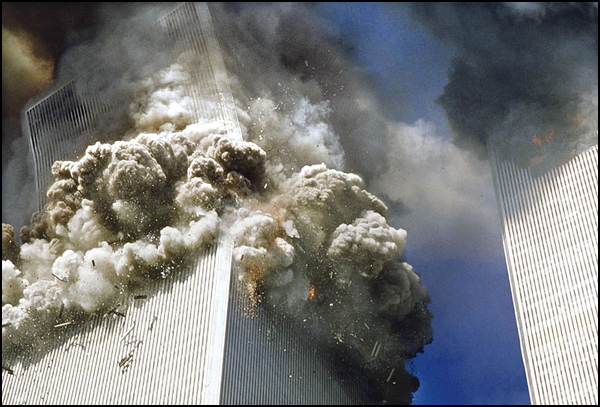
What did you answer? Did you say "That's the last moments of the lives of thousands of people"? Or "That's a vile act of mass murder"? Or "That's the beginning of a lifetime of suffering for everyone who loved someone who died at the World Trade Center"?
Wrong! The right answer is: that is an OPPORTUNITY, an ENORMOUS OPPORTUNITY:
"Through my tears I see opportunity." – George Bush, September 20, 2001
"If the collapse of the Soviet Union and 9/11 bookend a major shift in international politics, then this is a period not just of grave danger, but of enormous opportunity. Before the clay is dry again, America and our friends and our allies must move decisively to take advantage of these new opportunities." – Condoleezza Rice, April 29, 2002
2. What is this?
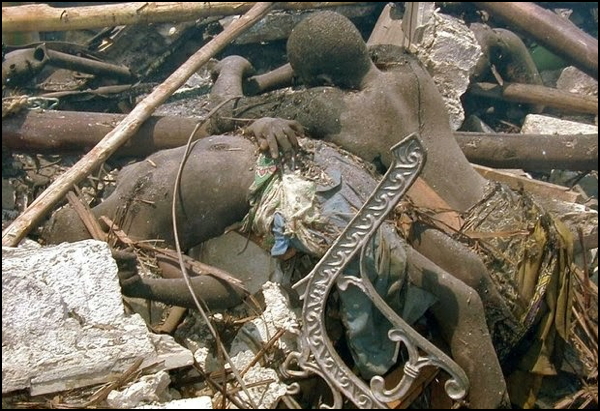
This question is a little harder. Some people might answer, "That's the result of an Al Qaeda bombing of a hotel in Mombasa, Kenya on November 28, 2002 aimed at Israeli tourists." Others might say, "It's the place where terrorists murdered 13 people, including ten Kenyans and Israeli brothers Noy and Dvir Anter, ages 12 and 13." Or, "That's the place where, CNN reported, 'screaming children covered in blood searched desperately for their parents amid the wreckage.'"
They would also be wrong. The correct answer is, that is a GOLDEN OPPORTUNITY:
"Foreign Minister Benjamin Netanyahu, meeting with ministry staff in the aftermath of the Kenya attacks, said that the incidents had presented Israel with a 'golden opportunity' to strengthen its strategic ties with the United States and other Western countries."
3. What is this?
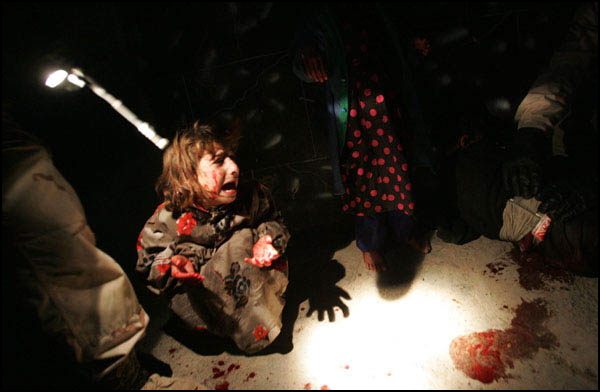
Some might guess, "That's a five-year-old Iraqi girl covered in the blood of her parents, who'd just been murdered by U.S. soldiers." Or, “That’s something that every American should be atoning for until the day we die."
But again, that would be wrong. The right answer is, that's yet another GOLDEN OPPORTUNITY:
"Targeting America in Iraq in terms of economy and losses in life is a golden and unique opportunity. Do not waste it only to regret it later." – Osama bin Laden, December, 2004
Probably the point here is clear. But I'll go ahead and spell it out.
For normal people, it's an unmitigated tragedy when their fellow citizens are killed in terrorist attacks or wars. Normal people cry, become afraid, and think of children who now have no parents and parents who now have no children.
For our would-be "leaders," however – in every country – the situation is different. Of course, they pretend to feel the same as normal people. They give teary-eyed speeches about sorrow and suffering.
And yet, behind their tears, there seems to be something else. When they think no one is looking, you glimpse another expression flitting across their face. You think it couldn't be. But – yes, incredibly enough, they're smiling. Because before the bodies are cold, before the mothers have stopped shrieking, our leaders are thinking:
This is really a FANTASTIC OPPORTUNITY.
And for them it is. It's an opportunity for them to do whatever they wanted to do before, but couldn't get away with. It's an opportunity for them to smear anyone who criticizes them as disloyal. It's an opportunity for them to become much more powerful than they ever could be in peacetime. Leaders love war. That's why there's so much of it.
It's understandably hard for normal people to come to terms with this. It's scary to believe your leaders may secretly be, uh, not so sad if you die. But all you have to do is listen to them, and they'll tell you.
Can we change this? Maybe. But the first step in changing reality is facing it, no matter how ugly and frightening it is.
Happy September 11th.
—Jon Schwarz
August 12, 2014
Hillary Clinton and Ayman al-Zawahiri Compete in Violent Moron Mad Libs
What should you do when you’re a violent, moronic leader, but your “side” starts protesting your moronic violence? It’s easy: just start wondering out loud why your “side” is complaining about your moronic violence, rather than the moronic violence of the other “side.” And if at all possible, blame your “side”’s protests on religious bigotry. It works the same everywhere; each time the violent, moronic leader just has to change a few nouns and adjectives.
For instance, here’s Hillary Clinton using this rhetoric in a recent interview in the Atlantic, as she explains that people protesting against the Israeli attack on Gaza were motivated by anti-Semitism:
When I asked her about the intense international focus on Gaza, she was quick to identify anti-Semitism as an important motivating factor in criticism of Israel. “It is striking … that you have more than 170,000 people dead in Syria. … and yet we do see this enormous international reaction against Israel, and Israel’s right to defend itself, and the way Israel has to defend itself. This reaction is uncalled for and unfair.”She went on, “You can’t ever discount anti-Semitism, especially with what’s going on in Europe today. There are more demonstrations against Israel by an exponential amount than there are against Russia seizing part of Ukraine and shooting down a civilian airliner. So there’s something else at work here than what you see on TV.”
And here’s al Qaeda’s current leader Ayman al-Zawahiri using the exact same rhetoric in 'The Exoneration', his response to criticism of al Qaeda by prominent Islamist Sayyed Imam Al-Sharif, to suggest that Al-Sharif is motivated by bigotry against Muslims:
This is a question that we address to the brothers who use the term "terrorism" to describe what happened in America. I would like an answer to it. This is the question:When the United States fired missiles on the medicine factory in Sudan, destroying it over the heads of the employees and workers who were inside, what do you call this? What America did against the Sudanese factory, does it not constitute terrorism but what those men did against the American buildings is terrorism? Why did they condemn what happened in America but we heard no one condemn what America did to the Sudanese factory?
I see no difference between the two operations except that the money used to build the factory was Muslim money and the workers who died in the factory's rubble were Muslims while the money that was spent on the buildings that those hijackers destroyed was infidel money and the people who died in the explosion were infidels. Was this the difference that made some of our brothers call what happened in America terrorism? They did not condemn what happened in Sudan and do not call it terrorism. What about starving the Libyan people? What about the almost daily starving of the Iraqi people and the attacks on them? What about the sieges and attacks on the Muslim state of Afghanistan? What do you call all this? Is it or is it not terrorism?
There is one difference between these two violent morons, however: one will probably soon control a gigantic nuclear arsenal.
—Jon Schwarz
July 17, 2014
Israel: In 1967 Blockades Were Acts of War, in 2014 They’re Totally Awesome
You probably assume there’s nothing funny about the Israeli attack on Gaza, with the death toll among Palestinians currently at 230. (One Israeli has also been killed.) But that’s where you’re wrong, if you just ignore the human suffering and enjoy the hilariously sanctimonious hypocrisy of nation states.
Two days after Israel and Hamas first started shooting on July 7th, Hamas proposed a ceasefire agreement. Gaza has been under an Israeli blockade since 2007, and Hamas wanted it lifted in return for a cessation of hostilities. Israel ignored this ceasefire proposal, and instead proposed a ceasefire with no lifting of the siege.
Hamas rejected this, which – according to U.S. State Department spokeswoman Jen Psaki – apparently makes every death on either side from now on their fault. (When asked about the killing of four Palestinian children on the beach yesterday, Psaki emphasized that Hamas was "putting their own people at risk” by not accepting the ceasefire.)
But how did Israel come to occupy Gaza in the first place? Well, in the Six Day War in June, 1967 Israel conquered Gaza (along with the West Bank, the Golan Heights and the Sinai).
Israel shot first in the Six Day War, and, as Israeli Prime Minister Menachem Begin later explained, it was a “war of choice” and there was "no proof" that Arab countries were going to attack them.
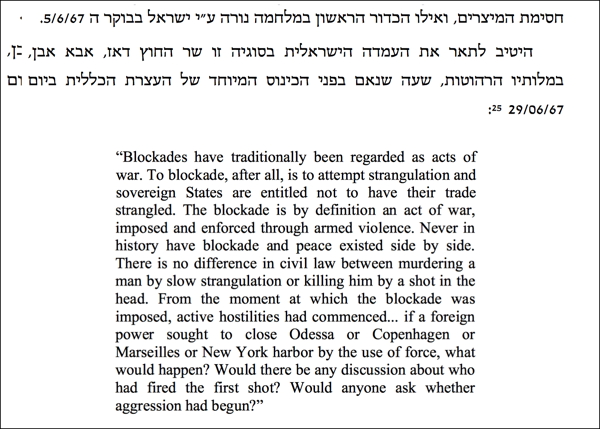
So what justification did Israel give at the time for shooting first? They said that in fact they hadn’t started the war, because Egypt had already started it by blockading an Israeli port several weeks before. Here's what Abba Eban, then the Israeli Foreign Minister and later the recipient of the Israel Prize, said to the UN General Assembly on June 19, 1967:
The blockade is by definition an act of war, imposed and enforced through armed violence. Never in history have blockade and peace existed side by side. From May 24 onward, the question who started the war or who fired the first shot became momentously irrelevant. There is no difference in civil law between murdering a man by slow strangulation or killing him by a shot in the bead. From the moment at which the blockade was imposed, active hostilities had commenced and Israel owed Egypt nothing of her Charter rights. If a foreign power sought to close Odessa or Copenhagen or Marseilles or New York harbour by the use of force, what would happen? Would there be any discussion about who had fired the first shot? Would anyone ask whether aggression had begun?
So that's the funny part:
By Israel’s standards, Hamas has been entitled (since the start of the blockade in 2007) to invade Israel and then occupy it for forty years.
Maybe Hamas officials should start pointing this out. They can direct curious reporters to the only place I can find Eban's speech online, the website of the Israel Defense Forces:
—Jon Schwarz